
In a data-driven world, it is vital for businesses to look at quantitative and qualitative data in order to improve efficiency and generate results. As the world evolves digitally, marketing just isn’t what it used to be anymore. Today, things are highly advanced and targeted hence, the focus has now shifted to being more result-oriented.
Gone were the days where generic approaches in businesses worked. In this digital age, consumers prefer a more personalized experience be it from a small-scale/large-scale business, which is why having access to the right data is exceptionally crucial for marketers today.
A Forbes article by Nicole Martin suggested that “utilizing past data and predictive analytics, businesses can now generate better return on investment (ROI) and provide insights that can lead to effective business strategies and decisions within an organization.”

A good example would be how Starbucks utilizes their data collected from their app to determine the busiest hours, most ordered drinks during certain times of day, seasonal trends, customer habits and preferences and much more. Such information were used to build marketing campaigns and promotions based on their customers’ demographics and locations.
I also recently watched a TEDTalk by Gary Kovacs on how online tracking can be dangerous in today’s context. Although slightly irrelevant, the video mentioned an important point on how within minutes, businesses are already tracking consumers’ online behaviour through the sites they have visited; and over a span of just ONE day, a whopping 150 sites have already been tracking Kovacs’ information. This goes to show how saturated the business of data collection is, in the current digital era.

So now we know how valuable data can be, how can businesses leverage on digital analytics to maximize their returns then?
Here are 3 steps to consider:

#1 KNOWING YOUR TARGET AUDIENCE AND CHANNELS
Having data allows you to know who you are communicating with and who are your potential prospects. Digital analytics allows businesses to track what kinds of people visits their website or social media platforms and what kinds of interaction these users have with them.
Some useful metrics to consider would be:
1. Pages per Visit – number of website pages viewed by an average user before they left
2. Average Visit Duration – average amount of time users spent on the site
3. Bounce Rate – the percentage of users that left your website after visiting only page
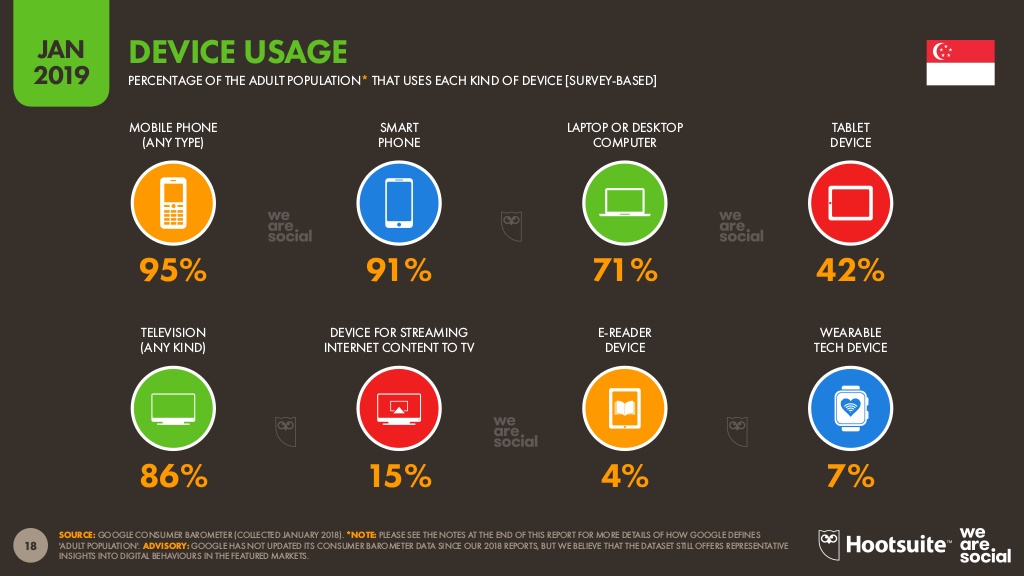
As seen from the info-graphic from Hootsuite, device usage differs amongst the adult population in Singapore; different demographics uses different methods of accessing online information. Taking into account the traffic source of users helps in identifying the correct channels to reach your audiences, which can make a huge difference in your digital marketing strategy.
#2 IDENTIFYING AND USING THE RIGHT KEYWORDS
Having data allows businesses to know what are the keywords your audience use to search for your product or service. Thus, enabling targeting and re-targeting of such keywords to drive more traffic to your channels.
Google Adwords is a great platform in determining potential keywords for your business. The software also allows businesses to determine what are their competitors’ keywords and use such data to generate a better strategy to propel their business further.
Most importantly, to consistently track and analyze these data to optimize the the business’ digital marketing strategies. A great tool to use would be Google Analytics. This tool allows businesses to monitor the data collected on many levels which can derive several results based on their needs.
At the end of day, the idea is to collect relevant data for improvement purposes, in order to reel in more traffic to your channels.
#3 SHOWING RETURN ON INVESTMENT
Stakeholders would want to know how the advertising money is being spent and whether the value has brought in profits also known as return on investments.

Some useful metrics to consider would be:
1. Conversion Rate – the percentage of visitors to your website that completed a desired goal out of the total number of visitors
2. Frequency – how frequent visitors come to your website
3. Time Gap of Transaction – time gap between the first time visitors visit your website till the date of transaction

Tracking the conversion rate allows businesses to analyze whether their traffic sources are targeted enough. Conversion rate comes in several forms based on business needs. For instance, it can be users filling up a form or users purchasing a product. The key is simply to attain a higher conversion rate.
Tracking the frequency allows businesses to analyze whether users are constantly coming back to your website be it for information/purchase a product etc. They key here is to attain a high frequency as the opposite would mean something might be wrong, causing users to leave. While analyzing the frequency, it is also crucial to identify the number of loyal users to know what are you doing right, and apply it to your channels as a whole.

Tracking the time gap of transactions allows businesses to analyze user much better. One way would be to segment your main channels. As different users visit your channels for different reasons, the key idea is to identify what are the channels that drives traffic. The higher the traffic, the smaller the time gap of transactions.
With that, digital analytics can be very essential if used correctly and efficiently. While it is a good quantitative indicator of success, utilizing it wrongly could put all your marketing resources to waste.
Now, let me leave you with a food for thought, what are the drawbacks of digital analytics then? Share with me your thoughts below!
Cheers.
 THE ROCKET MARKETER
hi there, what a detailed post you have there. I too, agree that some form of digital analytics are needed in today’s context when it comes to businesses. Some drawbacks of it are firstly, it is too dependent on technology and while it fails, a lot of things cannot be done. Secondly, privacy and security issues when it comes to external threats such as hackers. Although there might be more, digital analytics as a whole in general, is super beneficial for business today and in the future.
LikeLiked by 1 person
Hi Simone, thanks for the reply! Yes totally valid points. In addition to your first point on the dependency on technology, with increased use in digital analytics in businesses, the dependency on it increases as well. Like you’ve mentioned, while it fails, it may affect firms in many ways. Hence, without a proper back up plan to tackle such issues, businesses will have troubles moving forward.
I think a good way to avoid these issues is to not fully rely on analytics as a benchmark to move forward, instead, make use whatever data that is readily available for instance, past data/information, to plan the next step forward. Just an opinion though!
LikeLike
Hi Vincent, insightful stuff over here! It is definitely good to invest in digital analytic to get a profit in return. But, sometimes, a brilliant idea is all it takes to generate profit instead. Take, for instance, the famous ALS Ice Bucket challenge that generates millions of dollars and they did not have any form analytic to get there! You can check out more on how this challenge has marked as a viral marketing gold (https://digiday.com/marketing/ice-bucket-challenge-case-study-viral-marketing-success/). Cheers!
LikeLiked by 1 person
Hi, thanks for the reply! Yes of course, sometimes all you need is the “Aha!” moment or eureka moment to produce something extraordinary, be it a new business idea or a ground breaking product/service etc. However, analytics in this case allows businesses to gain insights on information that are valuable in potentially bringing the business further or like what I’ve mentioned in the post, targeting specific users who are potential prospects. Although I agree to some extent that analytics might not be everything, it certainly does value-add to businesses when being used effectively.
LikeLike
Hi Rocket Marketer! What an informative post on analytics! Data is king and firms who are able to use their data efficiently will gain the competitive edge. By acquiring the analytics, companies can understand their customers better so as to serve them well. Like your Starbucks example, they were able to figure out the busiest hours of the day and cater to customers accordingly. I came across an article that Starbucks opened their first mobile pick up store in Manhattan where customers can order on the app and grab and go! It truly amazing how analytics can help business thrive! Cheers
LikeLiked by 1 person
Hi Marcus, thanks for the reply! Yes, the mobile pick-up store was certainly an impressive feat. Today, people expect to receive their coffee as fast as their internet speed, and the concept of the pick-up store has definitely changed the fast-coffee industry. Of course, behind the scenes of the successful venture would be a lot of understanding on consumer behaviour and patterns. Hence like you’ve mentioned, using data efficiently would definitely allow businesses to gain the competitive edge.
LikeLike
Great post! I agree that data analytics is very good for businesses. I feel that some drawbacks of analytics are the interpretation of analytics. For example, analytics of demographics may be misleading as not all people in the same demographics behave the same way!
Nonetheless, great post! Looking forward to more!
LikeLiked by 1 person
Hi Marvin, thanks for reply! Super true, while analytics can be great for analyzing patterns and trends, intangible traits such as what you’ve mentioned, behaviour, can be very difficult to track. Hence, results can sometimes be skewed or unreliable.
LikeLike
Hi! awesome stuff you did here. Although digital analytics can benefit businesses in many ways, I think many businesses are unclear of what to analyze to improve their businesses, which brings me to my point of the learning curve of digital analytics. One drawback could be the knowledge of using analytical tools such as google adwords and google analytics. Without proper knowledge on how to use it, whatever strategies put in place would be of no use.
Thanks for the comprehensive post though!
LikeLiked by 1 person
Hi Ming Xuan, thanks for the reply! Interesting perspective indeed. In fact, having expertise in using such tools might just be the first step in digital analytics. Equally important could be the understanding of what various metrics mean in order to figure out what the business want to analyze. With the combination of the knowledge of metrics and usage of these tools, digital analytics like I’ve mentioned, can be a very useful implementation for organizations.
LikeLike